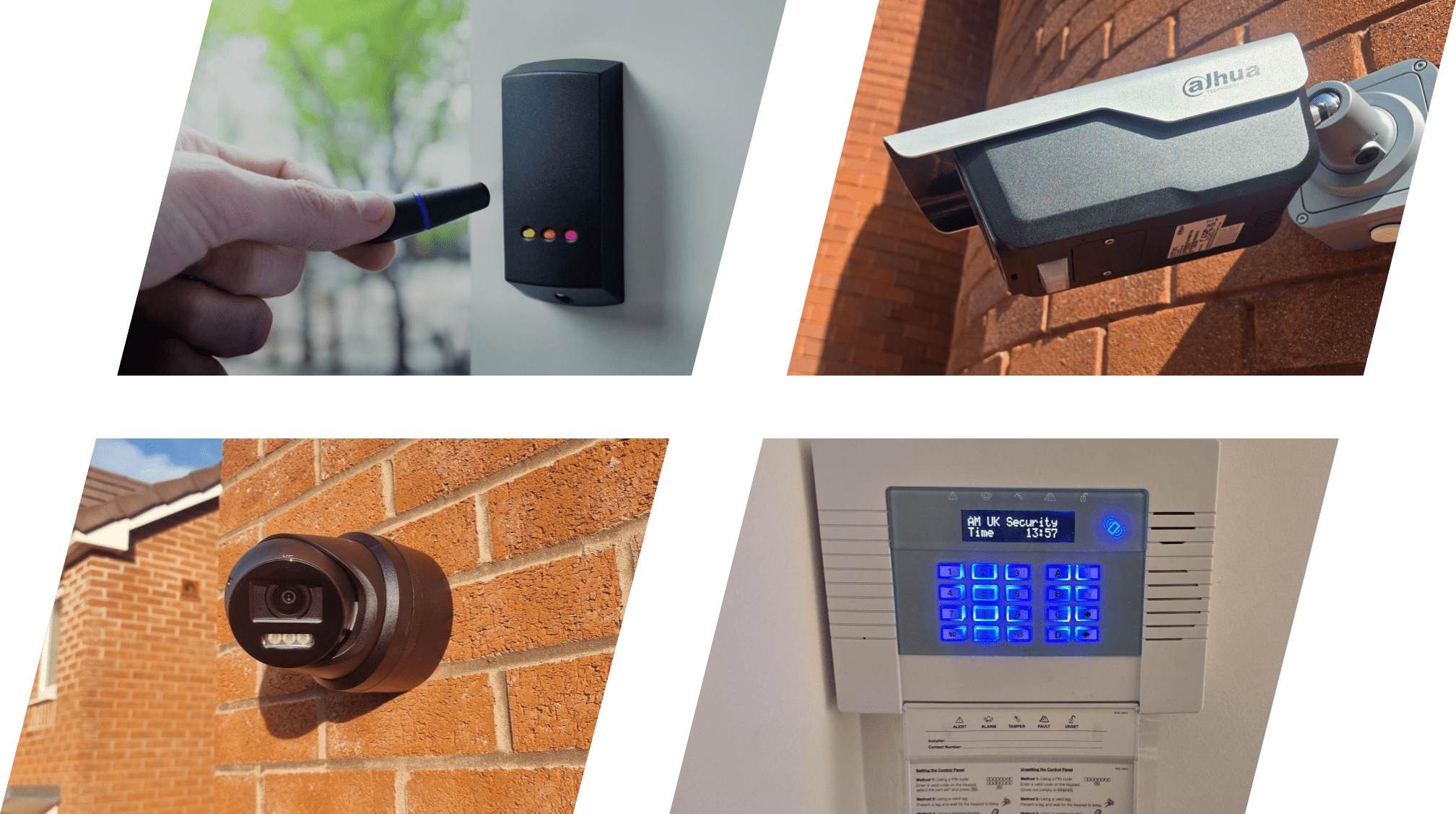
For commercial property owners, facility directors, and industrial site operators across the UK, securing external perimeters outside regular working hours remains a formidable challenge. While standard commercial CCTV systems record valuable video footage to local hard drives, passive recording offers zero intervention during an active break-in. In many cases, business owners only discover a security breach the following morning when faced with shattered windows, stolen equipment, and disrupted operations.
To prevent theft, criminal damage, and arson before intruders breach building envelopes, commercial facilities are increasingly shifting from passive recording to professionally monitored CCTV connected to an accredited Alarm Receiving Centre (ARC).
In this guide, we examine how remote CCTV monitoring works in real time, the technology driving automated perimeter tripwires, the deterrent power of live audio challenges, and how ARC-connected systems achieve priority police response across the UK.
1. Passive CCTV vs. Proactive Remote Monitoring
Understanding the difference between passive and remotely monitored surveillance is crucial when evaluating site vulnerability:
- Passive CCTV Systems: Cameras record video footage locally onto a Network Video Recorder (NVR) or cloud server. When an incident occurs, management reviews recorded playback retrospectively to determine how the breach occurred and provide evidence to local police forces. However, passive recording cannot halt criminal activity in progress.
- Remotely Monitored CCTV (ARC Integration): When your commercial facility closes for the evening, your IP camera network is armed. If an intruder attempts to scale a perimeter fence, enter a yard, or tamper with a delivery barrier, intelligent cameras transmit an instant video alarm feed to a certified $24/7$ Alarm Receiving Centre. Highly trained security controllers immediately assess the threat, issue live spoken warnings through horn speakers, and dispatch keyholders or emergency services within seconds.
By transforming video cameras into an active, verified security perimeter, remote monitoring prevents losses rather than simply cataloguing them.
2. How an Alarm Receiving Centre (ARC) Handles an Alert
The speed and precision of ARC monitoring relies on advanced edge-AI video analytics combined with structured operational workflows:
The 5-Step Rapid Response Workflow:
- Step 1: Target Crosses Boundary $\rightarrow$
- Step 2: AI Filters Out Weather/Wildlife $\rightarrow$
- Step 3: Instant Alert & Live Stream Transmitted to ARC $\rightarrow$
- Step 4: Live Spoken Audio Warning Issued $\rightarrow$
- Step 5: Keyholders & Emergency Services Dispatched
- Intelligent Target Detection: Modern commercial IP cameras utilize embedded deep-learning algorithms to detect human or vehicular movement crossing predefined virtual boundaries (tripwires or line-crossing zones). Background movement from wind-blown trees, heavy rain, or urban wildlife (such as foxes or badgers) is automatically filtered out to eliminate false dispatches.
- Secure Transmission to the ARC: Within seconds of a genuine breach, encrypted video alarm packets are transmitted over high-speed commercial data links (supplemented by $4\text{G}$/$5\text{G}$ failover) directly to the monitoring console.
- Visual Verification by Security Operators: A licensed monitoring specialist views the live camera feed alongside the seconds leading up to the trigger. This allows human operators to confirm an active trespasser instantly.
- Live Audio Interventions: The monitoring controller activates site-wide outdoor horn speakers to challenge the intruder with real-time, site-specific voice announcements.
- Emergency Response Escalation: If the individual fails to leave immediately or attempts forced entry, operators follow pre-agreed escalation protocols, contacting the designated local police constabulary and emergency keyholders.
3. The Power of Live Spoken Audio Challenges
One of the single most effective components of remote CCTV monitoring is the live audio challenge.
Pre-recorded siren blasts or automated voice loops are frequently ignored by seasoned criminals, who recognize automated recordings and assume no real human is watching. In contrast, an operator broadcasting a live, specific verbal challenge directly to the intruder radically changes the psychological dynamic:
“Attention: You are trespassing on private commercial property in Stratford-upon-Avon. You are being monitored on live CCTV wearing a grey hooded sweatshirt near loading bay two. Police have been notified. Leave the premises immediately.”
Industry statistics indicate that over $90\%$ of trespassers flee immediately upon hearing a direct, personalized voice broadcast. Criminals understand that their physical anonymity is compromised and that security response teams are already en route.
4. UK Regulatory Compliance: BS 5979 and BS 9518 Standards
To ensure total operational reliability and meet commercial insurance criteria, remote monitoring must be carried out by accredited facilities adhering strictly to British and European standards:
- BS 5979 / BS EN 50518: The standard governing the physical construction, data resilience, physical security, and communication redundancy of Alarm Receiving Centres. These facilities operate from subterranean or fortified buildings equipped with independent power generators, dual telecom routes, and blast-resistant monitoring suites.
- BS 9518: The UK code of practice for the processing of signals from video surveillance systems (VSS) within an ARC. It defines maximum operator response times, visual verification criteria, and auditing procedures for security handling.
- BS 8418: The definitive British Standard for the design, installation, and remote monitoring of detector-activated CCTV systems. Compliance with BS 8418 is frequently a mandatory requirement set by commercial property insurers for high-risk industrial depots, vehicle storage yards, and plant hire sites.
Operating an installation that meets these standards guarantees that alarm signals are audited, verified, and managed according to strict life-safety and security regulations.
5. Securing a Unique Reference Number (URN) for Priority Police Response
When an unmonitored commercial burglar alarm trips, police forces across the UK generally treat it as a low-priority automated alert. Because up to $95\%$ of unverified automated alarms turn out to be false alarms caused by spiders, drafts, or user error, police will not attend unverified signals unless someone on-site physically confirms a break-in.
Under the National Police Chiefs’ Council (NPCC) Security Systems Policy, monitored systems installed to BS 8418 and connected to an accredited ARC can be issued an official Unique Reference Number (URN) by the local constabulary (such as Warwickshire Police or West Midlands Police).
When an ARC operator visually verifies an intruder on live video:
- The operator calls the police control room via dedicated, priority CAD dispatch lines.
- The operator quotes the facility’s active CCTV URN and confirms a “crime in progress with visual verification.”
- The police dispatch team upgrades the incident to a Level 1 Immediate Response, ensuring patrol units are dispatched without delay.
6. Commercial Cost Comparison: Remote Monitoring vs. Manned Guarding
For expansive commercial sites, logistics parks, and builders’ merchants, securing the perimeter with physical, on-site manned security guards represents one of the largest ongoing operational expenditures (OpEx).
| Security Factor | On-Site Manned Guarding | Remote Monitored CCTV (ARC) |
| Annual Operating Cost | High (£50,000 – £120,000+ per year for 24/7 guard cover) | Substantially Lower (Typically 80% to 90% savings compared to physical guards) |
| Coverage Area | Limited to the physical location of the guard on patrol | Simultaneous, unblinking multi-camera perimeter coverage across $360^\circ$ |
| Personal Safety & Lone Worker Risk | Guards face direct physical risk from violent intruders | Zero physical risk to monitoring operators housed off-site in fortified control rooms |
| Incident Response Speed | Relies on patrol schedules; delayed if guard is on the opposite side of site | Instant tripwire triggers alerting operators in under $10\text{ seconds}$ |
| Visual Evidence Gathering | Human memory and bodycam (if worn) | Synchronized 4K video recording with cloud-backed incident exports |
While manned guards remain valuable for specialized access control or concierge hospitality, combining automated barriers with remote CCTV monitoring delivers superior physical deterrence and massive financial savings for most commercial properties.
Protect Your Premises in Real Time with AMUK Security
Relying on unmonitored CCTV cameras leaves your business vulnerable to after-hours property damage and stock loss. Upgrading your commercial surveillance to a proactive, ARC-monitored perimeter ecosystem ensures your facility is defended $24$ hours a day, $365$ days a year.
At AMUK Security, we design, install, commission, and maintain insurance-compliant, remotely monitored IP CCTV and perimeter security networks across Warwickshire and the West Midlands. Our certified installation engineers configure intelligent AI line-crossing cameras, IP public-address horns, and encrypted ARC links built to rigorous British Standards.
Looking to stop intruders before they enter your building?
Contact AMUK Security today to schedule a commercial remote monitoring site audit.